TL;DR
Over 114,000 tech workers have been let go in 2026, with company after company citing AI as the driver. But look closer and you find overpriced acquisitions, pandemic-era bloat, and failed bets being written off under the most convenient cover story of the decade. The real casualty isn’t the headcount—it’s the institutional knowledge walking out the door. There’s a better way to run this pivot.
Introduction
Look at the image below. I saw a similar image somewhere on the net and had to ask myself who’s next, these three cartoon figures, stretched at the seams, company shirts straining—employees bursting through the fabric. “Is your company next?”
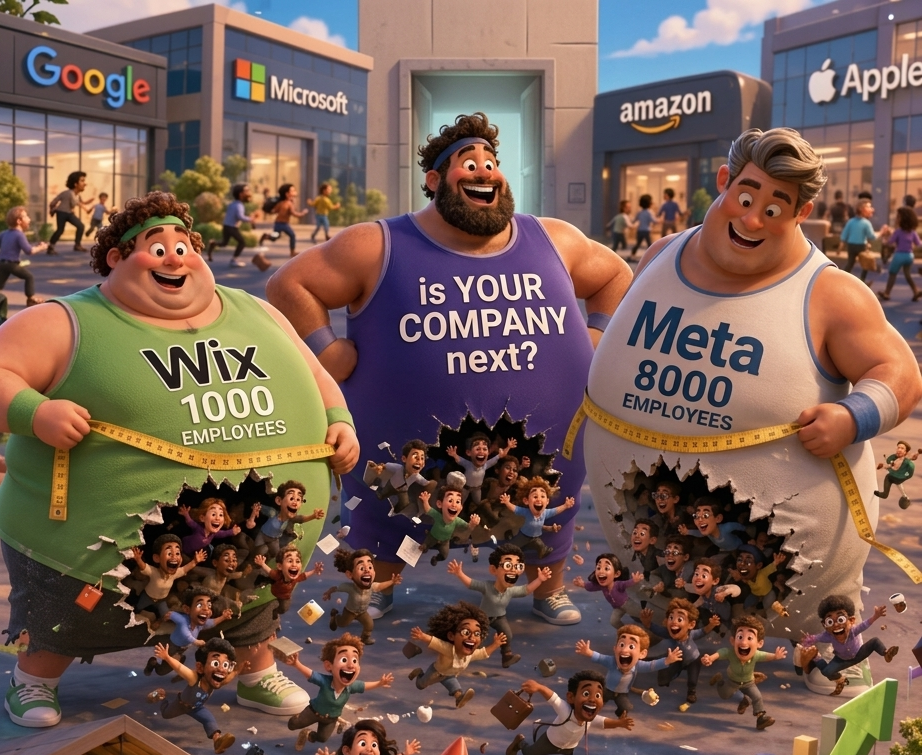
It’s a darkly accurate metaphor for 2026. Barely a week passes without another headline: Meta cuts 8,000. Intuit slashes 17%. Wix plans 1,000 layoffs—its largest ever. And right here in Israeli high-tech, a sector that spent the better part of a decade growing without pause: ZoomInfo shutters its entire Israel R&D center, AI21 Labs cuts over 60% of its workforce, BigID trims 20%.
The narrative is almost always the same: AI made us do it.
I’ve been in this industry for 25 years. I’ve seen the dotcom bust, the cloud migration wave, the DevOps transformation, the container revolution. Every wave comes with a story about why the old way of working—and the people who embodied it—is no longer relevant. Usually, the story is more complicated than the press release.
This time is no different.
AI as Cover Story: Reading the Actual Balance Sheets
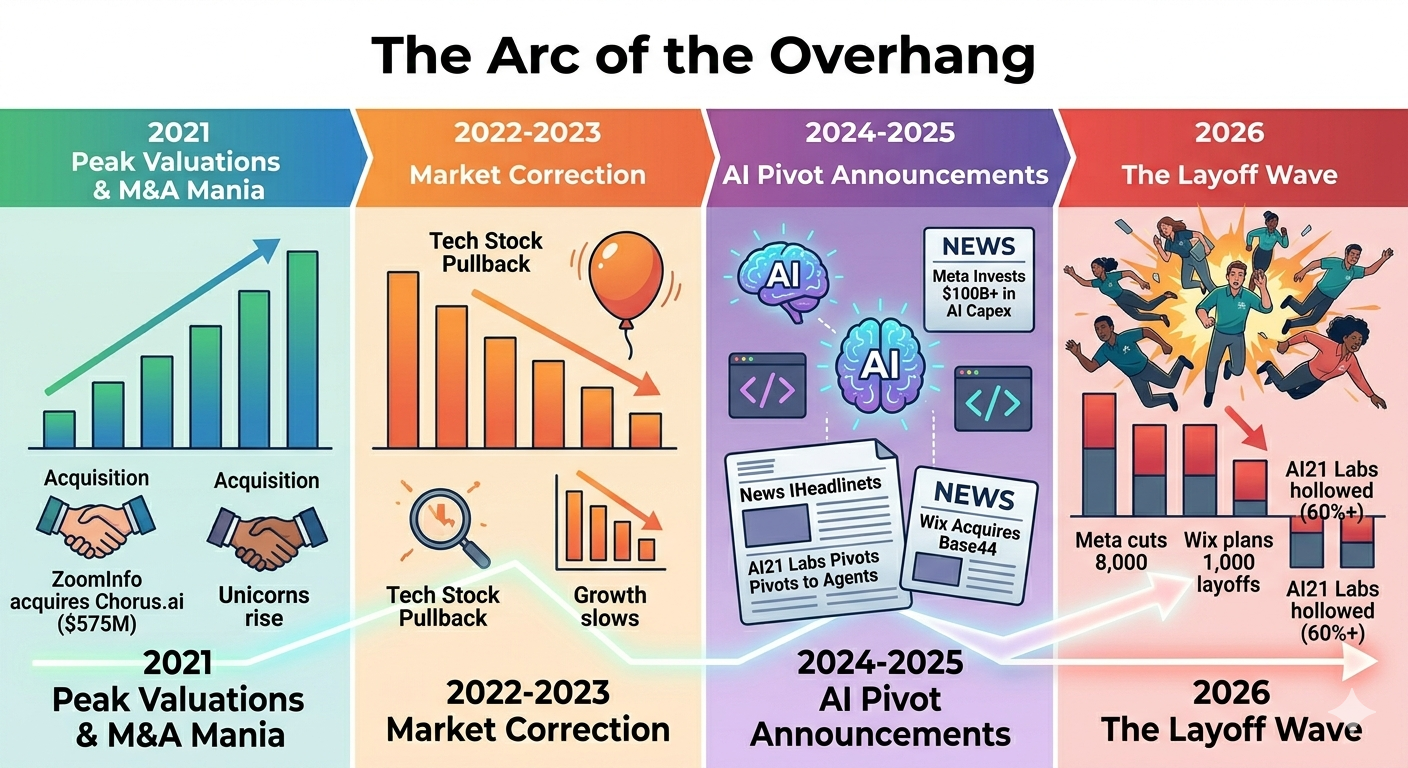
Let’s start with the most cited example. Meta cut 8,000 employees in May 2026. At the same time, it posted record Q1 revenue of $56.3 billion with $26.8 billion in net income—and raised its 2026 capital expenditure guidance to between $125 billion and $145 billion, almost entirely for AI infrastructure. The layoffs free operating budget to feed that capex number. Meta didn’t lay off 8,000 people because GPT-5 can write marketing copy. It spent a decade and tens of billions building a metaverse that nobody wanted, and now it’s correcting course. AI is the strategy pivot. It’s also the cleanest narrative for investors.
Intuit is a sharper case. The CEO went on CNBC and said outright: “None of it had to do with AI.” Seventeen percent of the workforce—approximately 3,000 people—gone in a “builder culture” restructuring meant to simplify the organizational structure and accelerate delivery. At the same moment, Intuit signed multi-year deals with Anthropic and OpenAI to embed their models into TurboTax and QuickBooks. So the actual picture is: swap headcount for API costs, accelerate delivery with fewer people, embed AI into the product. That’s a financial restructuring with an AI component—not a robot replacement story.
Then there’s Wix, and as someone in the Israeli tech community, this one stings a little to analyze.
Wix acquired Base44—an AI-powered “vibe coding” platform—for $80 million in June 2025. A smart bet: Base44 hit $150 million in annual recurring revenue by May 2026. But the financial execution was reckless. The company paid Base44’s founder $38 million in Q1 2026 alone, with more payments scheduled. It launched a $1.6 billion share buyback that drained cash reserves to $900 million. It ran two Super Bowl commercials—one for Wix, one for Base44. Revenue grew 14% to $541 million. Operating expenses jumped 50% to $423 million. The result: a $57.5 million quarterly loss after several profitable quarters, and a stock that lost half its value in 2026. The 1,000 layoffs—20% of the workforce—aren’t an AI story. They’re a spend discipline story.
ZoomInfo closes a grimmer chapter. In 2021, at the peak of the market, the company acquired Israeli startup Chorus.ai for $575 million. At the time, CEO Henry Schuck called ZoomInfo “arguably the largest public company in Israel.” Five years later, the entire Israel R&D center—around 300 of 600 employees—is being shut down, with the remainder of 600 global positions eliminated alongside it. The company’s market cap has fallen from over $30 billion to around $1.3 billion. A 96% decline. The press release says AI-driven restructuring. The balance sheet says: overpriced acquisition, market downturn, and a product facing direct competitive pressure from AI-native sales intelligence tools.
And AI21 Labs tells perhaps the most instructive story of all. Once valued at $1.4 billion, the company raised $700 million to compete in the large language model race—going head-to-head with OpenAI, Anthropic, and Google. That race required compute budgets that no Israeli startup could sustain. After acquisition talks with Nebius, Nvidia, and Google all failed to produce a deal, AI21 cut over 60% of its workforce—approximately 110 of 180 employees—abandoned standalone LLM sales entirely, and pivoted to its Maestro AI agent optimization platform. Nebius, the acquirer that never was, signed a commercial partnership instead—paying tens of millions for the technology and engineering talent in what sources describe as an acquihire-style arrangement. A $1.4 billion unicorn, hollowed to 70 people. Not because AI replaced them—because they tried to build foundational AI infrastructure and ran out of runway competing against companies with effectively unlimited capital.
BigID, the Israeli data security unicorn that peaked at a $1.25 billion valuation, cut 20% of its staff in the same week, with co-founder Nimrod Vax framing it as fully embracing “the biggest technological change of our career.” The headline is AI transformation. The subtext is: the data governance market is being restructured by AI-native tools, and companies that built on the old model are scrambling to reposition before the window closes.
The AI Race Nobody Is Currently Winning
Here’s the financial reality that gets buried under the transformation announcements: nobody except Google has actually figured out how to make AI pay at scale.
OpenAI is projected to lose up to $14 billion in 2026 despite annualized revenues exceeding $20 billion—because the compute costs are that extreme. Anthropic surpassed $40 billion in annualized revenue and reported its first operating profit in a single quarter, but company-wide profitability isn’t projected until 2028. Google Cloud hit $20 billion in Q1 2026 revenue, up 63% year-on-year, with generative AI services growing nearly 800%—that’s what winning looks like, and Google got there by having the infrastructure already. Tesla’s Full Self-Driving subscription generates near-100% gross margins across 1.28 million active subscribers, but it’s still a rounding error relative to EV hardware sales.
Every company cutting headcount to “invest in AI” is making a bet on future returns that the current economics don’t yet support. Most of them are buying API access to OpenAI or Anthropic—companies that are themselves operating at massive losses—and betting that their customers will pay enough of a premium to cover the switch.
That bet might be right. But it’s a bet. Presenting it as an inevitable AI efficiency story strips out the uncertainty.
The Problem Nobody Talks About: What Walks Out With Them
I’ve spent a significant portion of my career at Tikal Knowledge consulting for Israeli software vendors and enterprises. One thing I’ve learned: the most valuable asset in most organizations isn’t the code. It’s the context—why certain decisions were made, which vendor turned out to be a dead end, where the regulatory landmine is buried in the legacy system, how to navigate the customer’s actual requirements versus their stated ones.
That knowledge lives in people’s heads. It accumulates over years of production incidents, architecture debates, client escalations, and hard-won lessons. You can’t fine-tune a model on it, because most of it was never written down.
When companies lay off experienced engineers to fund AI tooling, they’re doing a very specific trade: replacing domain expertise with general capability. That can work in some domains. In most complex enterprise environments—regulated industries, multi-cloud infrastructure, vertically-specific product development—it doesn’t. The AI tools are only as useful as the prompt quality, and the prompt quality depends on understanding the problem deeply enough to ask the right question.
Salesforce is now hiring “AI-native graduates”—people who learned to code alongside AI assistants from day one. That’s genuinely interesting. But it raises a question worth sitting with: what happens to the institutional knowledge that universities and decades of industry experience built, if the new graduates never develop deep independent judgment before augmenting with AI? The productivity multiplier is real. So is the risk that you end up with a generation of engineers who can move fast but don’t know why the guardrails were there in the first place.
Two Things Worth Taking Away
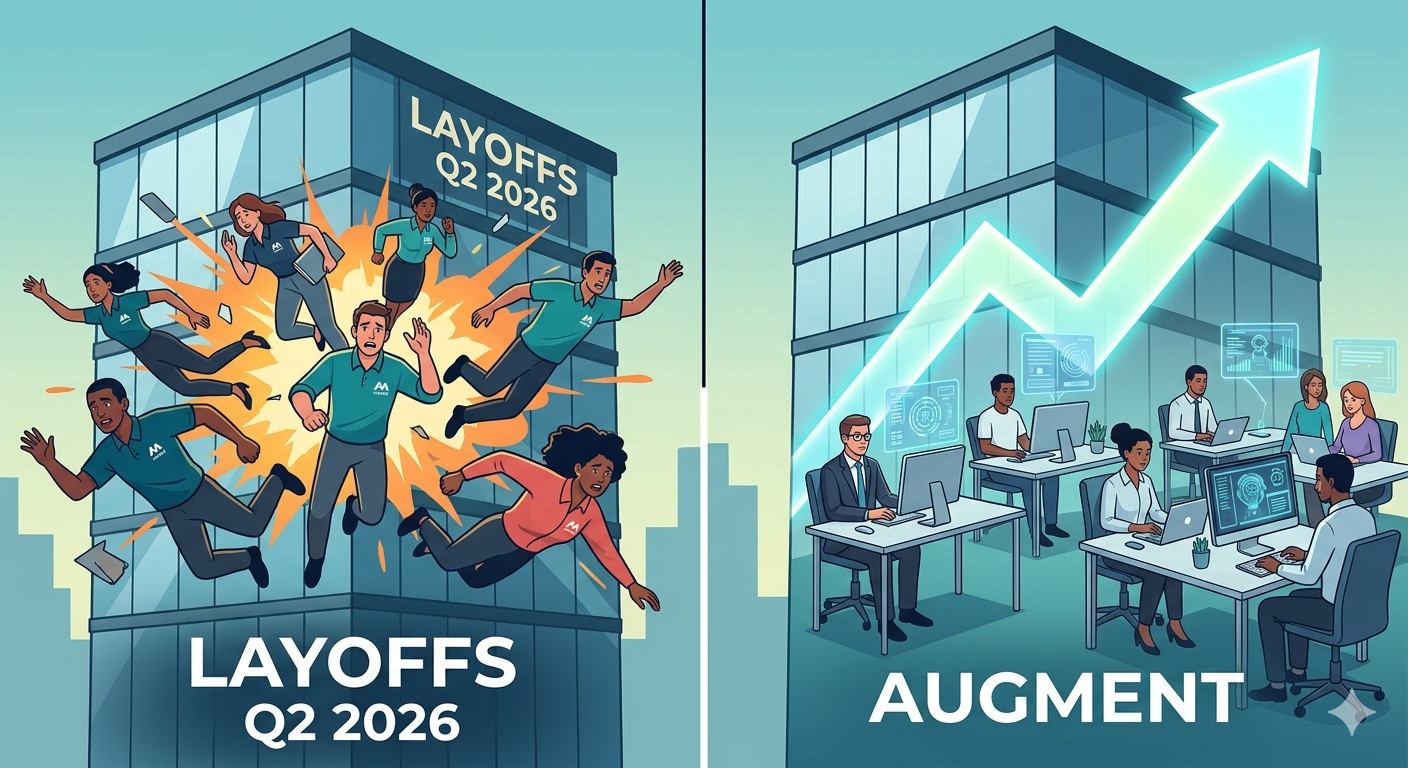
For individuals: AI is a force multiplier. It doesn’t replace engineers who understand their domain—it makes them dramatically more effective. The engineers I know who’ve embraced these tools aren’t worried about their jobs. They’re getting more done in a week than they used to in a month. The ones who will be displaced aren’t being replaced by AI—they’re being replaced by colleagues who adopted it. This is your leverage, not your competition. Invest in learning how to use these tools at the level of your actual expertise, not at the surface level. That’s where the multiplier is.
For companies: The smarter play is augmentation, not reduction. Think about how you’ve invested in software over the last decade—you bought tools to accelerate your teams, not to replace them. AI is the same category of investment. The institutional knowledge in your experienced engineers is a competitive moat that took years to build. It doesn’t regenerate quickly once it’s gone. Before you model out the headcount savings from AI-driven automation, model out the cost of losing the context that makes your product defensible.
Business has always been about making the right decisions on time. The companies in a panic right now—overpaying for AI acquisitions, buying back shares to reassure investors, running Super Bowl commercials for products that aren’t yet profitable—are making the same mistake companies always make under technological pressure. They’re optimizing for the announcement, not the outcome.
The ones who will look smart in five years are the ones investing in their people’s ability to use AI, not the ones trading people for API subscriptions.
Conclusion
The layoff wave of 2026 has a single, convenient headline: AI did this. The real story is more expensive and more interesting—decades of overinvestment, pandemic-era hiring that never fully corrected, acquisition premiums that made no sense at any interest rate, and a race to appear AI-ready to investors before actually being AI-capable.
What I hope you take from this: the technology isn’t the threat. The panic around it is. If you’re an individual, the best thing you can do is become someone who uses AI to do more—not someone who waits to see if the wave is real. It’s real. And if you’re building or leading an organization, the question isn’t how many roles you can automate. It’s how much faster your experienced people can move when they have the right tools.
That’s the bet worth making.
Discussion