TL;DR
On June 4, Anthropic published “When AI builds itself” and asked the industry to keep open the option to pause frontier development before AI systems start designing their own successors. The data behind it is real and specific — 80%+ of Anthropic’s merged code is now Claude-authored, and a research-loop benchmark jumped from ~3x to ~52x speedup in a year. But the same company is heading toward a near-trillion-dollar IPO, and the proposal is “build a brake pedal,” not “press it.” That gap between the alarm and the ask is the part worth reading closely — especially if you ship infrastructure for a living.
The post that made my feed lose its mind
A friend forwarded me a Hebrew news headline this week: “Before we lose control: Claude’s maker calls to halt AI development.” The kind of headline engineered to be screenshotted. My first reaction was the same one I have to every “AI will end us” headline — open the primary source and see what was actually said, because the headline is almost never it.
So I read the actual piece. It’s worth your time. It’s also more careful, more data-backed, and more self-interested than the headline lets on — all at once.

What the report actually claims
The piece, authored by Anthropic’s Jack Clark and Marina Favaro, argues that AI is no longer just accelerating human work — it’s accelerating its own development. The term they use is recursive self-improvement (RSI): the point at which a system can autonomously design and build its successor with little human input. Their explicit position is that we’re not there yet, it isn’t inevitable, but it “could come sooner than most institutions are prepared for.”
The receipts are what separate this from the usual doom essay. Pulled straight from the report:
- 80%+ of code merged to Anthropic’s production codebase in May 2026 was authored by Claude — up from low single digits before Claude Code shipped in February 2025.
- The typical Anthropic engineer merges ~8x as much code per quarter as they did in 2024.
- On an internal training-loop optimization task, Claude went from a ~3x speedup (Opus 4, May 2025) to ~52x (April 2026). For calibration, a skilled human needs four to eight hours to reach 4x.
- On a multi-agent AI-safety research problem, agents recovered 97% of a performance gap over ~800 compute-hours and ~$18k, where two human researchers recovered ~23% over about a week.
To their credit, they flag the soft spots themselves: lines-of-code is a quantity metric, not quality; the 52x figure depends heavily on how bad the starting code was; the research result “didn’t transfer cleanly to production-scale models.” The footnotes are honest in a way the headline isn’t.
The ask at the end is narrow and specific: the option to slow or pause, enabled by a verification system so that one lab pausing doesn’t just hand the lead to a less cautious one. Jack Clark’s own framing — the industry has a gas pedal but no brake pedal, and they want to help build the pedal.
Why a platform engineer should care about an alignment essay
You might file this under “interesting, not my problem.” I’d push back. Strip away the existential framing and the report is describing a workflow shift that’s already in your pipeline.
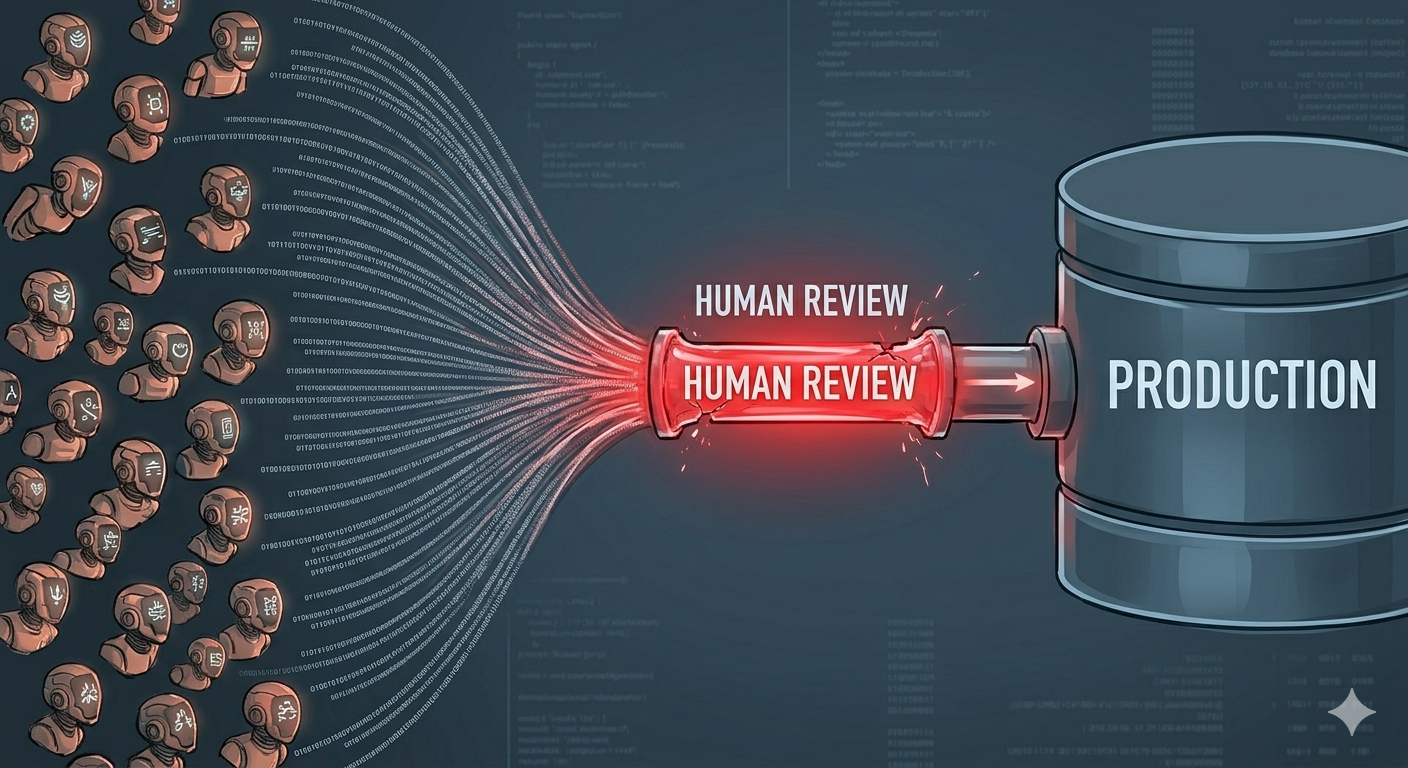
Read the engineering claims again as an SRE: the human role is collapsing from writing to reviewing, and review is becoming the new bottleneck. Anthropic says it out loud — they now run an automated Claude reviewer on every merge, and a retrospective found it would have caught roughly a third of the bugs behind past production incidents. That’s not a philosophy seminar. That’s a change-management policy. It’s the exact problem every platform team is about to inherit: when an agent can open more correct-looking PRs than your humans can meaningfully review, your merge gate is your safety boundary.
This is the part I find genuinely useful, independent of whether RSI ever arrives. The bottleneck-shifting they describe is just Amdahl’s law wearing a lab coat — speed up one stage and the slowest unautomated stage now governs your throughput. We’ve all lived this. You autoscale the app tier and discover the database was the wall all along. The report’s most defensible claim isn’t “AI will build its successor.” It’s “the doing now costs almost nothing, so the judgment and the verification are all that’s left.” That’s a true statement about a CI/CD pipeline in 2026, full stop.
The part the headline buried
Here’s where I have to be the skeptic, because the timing deserves it.
This report did not land in a vacuum. It landed while Anthropic — by reporting from Al Jazeera and others — is racing toward a public listing that could value it near a trillion dollars. A company telling the world “our technology is so powerful it might escape human control” is making an alarming claim and a bullish one in the same breath. “Please consider regulating us” and “our product is on a near-vertical capability curve” are, conveniently, the same sentence to two different audiences.
I don’t think that makes the data fake. I’ve read the charts; the trendlines are the trendlines. But I’ve sat in enough vendor briefings to recognize the move: a capability claim dressed as a caution. The safest possible way to advertise that your model is approaching superhuman engineering ability is to warn the public about how dangerous that ability is. You get the credibility of restraint and the marketing of inevitability for free.
And notice what’s not being proposed. Not a pause. Not even a commitment to pause. The ask is to build the machinery that would make a coordinated, verifiable pause possible someday — contingent on every other frontier lab, in multiple countries, agreeing to stop under the same verifiable conditions. The report itself concedes that detection of a secret training run is harder than spotting a missile silo, and that the comparable arms-control regimes “took decades to build.” So the honest reading of the proposal is: here is a brake pedal that requires unanimous international cooperation to install, and we’ll keep driving until it exists. That is a very different statement than the headline’s “calls to halt.”
What I’d actually do with this
I’m not in the business of grading civilizational risk. I’m in the business of helping ISVs ship safely. So here’s the practitioner translation, holding the existential question at arm’s length:
- Treat your merge gate as a control plane, not a formality. If agents are writing a growing share of your diffs — and in many shops they already are — the review step is now a load-bearing security boundary. Invest there: policy-as-code on the PR, required automated review, provenance on what an agent touched. This is true whether or not you believe in RSI.
- Instrument the human-judgment stage. The report’s least-automatable claim is “research taste” — choosing which problems matter. The platform-eng equivalent is architectural judgment and trade-off calls. That’s where to keep humans, and where to measure whether you’re keeping them.
- Read primary sources, share headlines never. The gap between “calls to halt AI development” and “wants the option to build a verification regime that would enable a coordinated pause” is the entire story. If a headline could be a screenshot, assume it’s been optimized for the screenshot.
Conclusion
The report is the most data-rich thing a frontier lab has published about its own internal acceleration, and that alone makes it worth reading over the news coverage of it. The bottleneck argument is real and it’s already in your pipeline. The risk framing may well be sincere — Anthropic has spent years positioning as the cautious lab, and some of that has cost them. But “we might lose control” and “buy our stock” being the same press release is a coincidence I’m not equipped to ignore. A brake pedal that only works if everyone installs theirs at the same time isn’t a brake pedal. It’s a position paper with a really good headline.
Add to GLOSSARY const in src/layouts/PostLayout.astro: ‘RSI’: { full: ‘Recursive Self-Improvement’, url: ‘https://www.anthropic.com/institute/recursive-self-improvement’ }, ‘IPO’: { full: ‘Initial Public Offering’, url: ‘https://en.wikipedia.org/wiki/Initial_public_offering’ }, ‘PR’: { full: ‘Pull Request’, url: ‘https://docs.github.com/en/pull-requests’ }, —>
Discussion