TL;DR
My personal AI tooling bill cleared $1,200 last month — over $1,000 in Cursor, ~$200 in Claude — and that’s after already running Headroom and Ponytail to cut tokens, and before I’ve touched video or image generation, which would push it higher still. The contrarian part: this isn’t a sign I’m doing something wrong. Gartner calls it the “Inference Paradox” — unit token prices keep falling while total bills keep climbing, because every capability jump makes us spend more tokens per task, not fewer. Optimize the transport layer all you want; the real lever is deciding which tasks deserve an agent at all — and once you stack that $1,200–$1,500 against a single engineer’s day rate, the number stops looking scary.
Originally published at portfolio.hagzag.com.
The Bill That Didn’t Make Sense Until It Did
I pulled up my invoices for a routine monthly review — nothing unusual, just checking spend before renewing a client’s platform budget — and found my own personal tooling had quietly crossed four figures. Cursor alone had gone north of $1,000. Claude sat around $200 on top of that. No video generation, no image generation, nothing exotic. Just agentic coding, day in, day out, across client work in medical-adjacent and financial-sector engineering.
The part that stopped me wasn’t the total. It was that I’d already done the “right” things. I run Headroom in front of my Anthropic traffic to keep context compressed and cacheable. I run Ponytail to keep agents from generating more code than a task needs. Both are supposed to bend the cost curve down. And the bill still climbed.

Cheaper Tokens, Bigger Bills — The Math Behind the Paradox
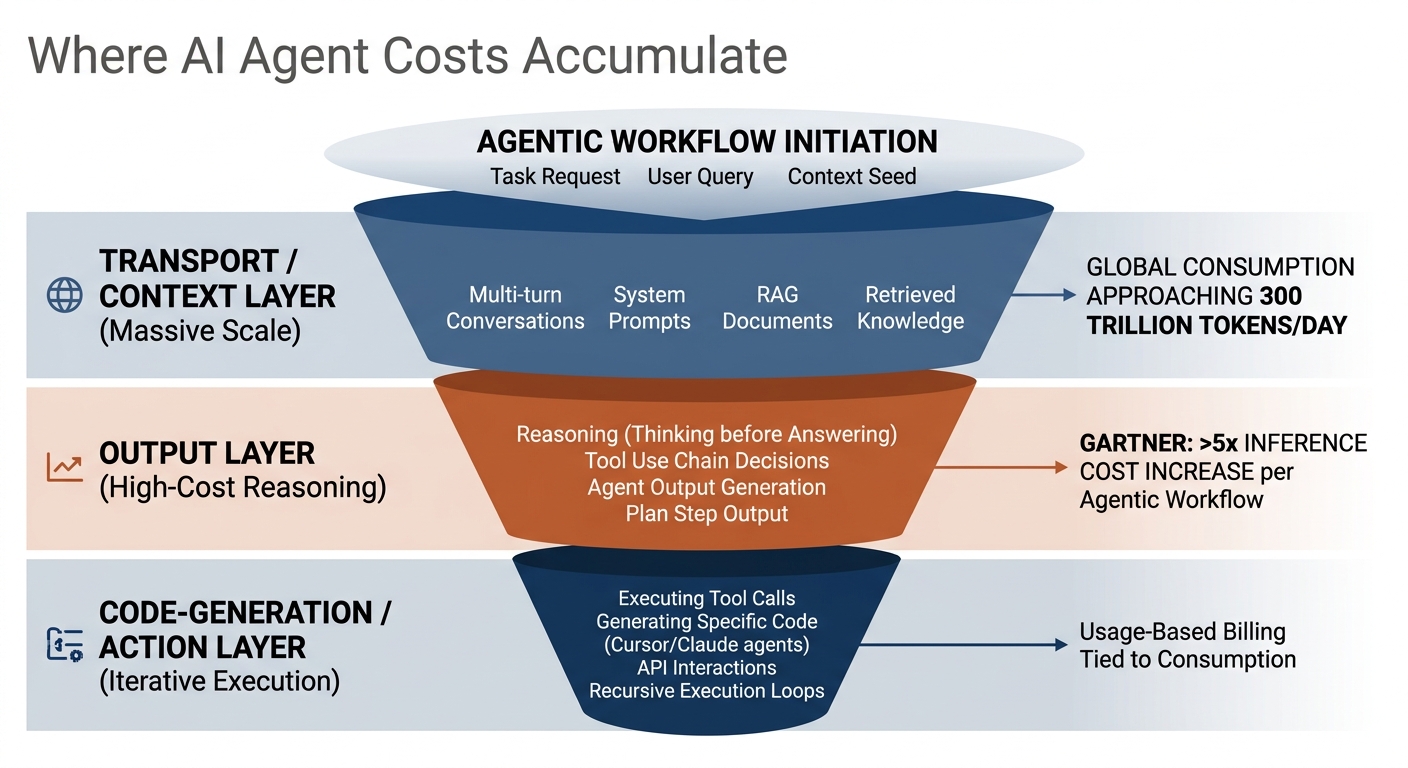
This isn’t just an anecdote. Gartner’s Will Sommer put a name on it in an August 2026 report: the Inference Paradox. Foundation model token prices are genuinely falling — that part is real and it’s a win for everyone. But the capability unlocked by cheaper tokens gets spent immediately on more expensive workflows: reasoning models that think before they answer, agents that chain dozens of tool calls, multi-step pipelines that re-send the entire conversation transcript on every single turn. Gartner expects inference costs per agentic workflow to increase more than fivefold through 2028, even as the per-token price keeps dropping, and projects global token consumption approaching 300 trillion tokens a day.
Josh Bersin’s framing lands the same punch from a different angle. He points out that Anthropic has shifted enterprise pricing toward usage-based billing tied to actual consumption rather than flat seats, and that CIOs are already telling him they’re “bracing for volatile costs” as employees ramp up agentic tool use. He also runs a comparison I found clarifying: an original IBM PC from 1981, adjusted for inflation, would cost about $5,700 today; a solid laptop now runs closer to $3,000. That’s the kind of price-per-compute deflation we got used to for forty years. AI isn’t following that curve. The infrastructure behind it — hundreds of billions in hyperscaler capex, a 2026 run-rate approaching $1 trillion once you count chipmakers and cloud builders — has to get paid back somehow, and “somehow” increasingly looks like our invoices.
None of this means costs are irrational. It means the assumption a lot of us are quietly carrying — that AI, like most software, gets cheaper over time — doesn’t hold for agentic workloads. The capability curve and the cost curve are moving together, not apart.
Where My Own Optimization Stopped Working
Here’s the part that’s less comfortable to admit: Headroom and Ponytail did exactly what they promised, and my bill went up anyway. That’s not a contradiction — it’s the paradox playing out on a single laptop instead of an enterprise balance sheet.
Headroom keeps my request prefixes cache-stable and compresses context by content type before it hits the Anthropic API — a real, measurable win on the “transport” side of the token bill. Ponytail nudges agents toward the smallest correct solution instead of the first one that compiles, which cuts how much code gets generated (and re-sent as context) in later turns. Both layers are real engineering, not snake oil, and I’d recommend either one to any team running Claude Code or similar agents at volume. Amit Karni, a colleague of mine at Tikal, wrote up a solid breakdown of stacking these alongside Caveman (an output-trimming skill) if you want the mechanics.
What neither layer touches is the decision to spin up an agent in the first place, and how ambitious a task I hand it once it’s running. I’ve caught myself using an agentic loop for tasks that a five-line script would have solved, simply because typing the prompt was faster than writing the script. That’s the actual cost driver — not inefficient transport, but scope creep in what I ask agents to do, multiplied across every session. Optimizing the pipes while the water usage keeps growing gets you a smaller increase, not a decrease.
What I’d Do Differently Going Into 2027 Budgets
For client engagements, I’m changing how I scope agentic work rather than hoping the next model generation comes with a discount:
- Treat agent invocation as a build decision, not a chat message. If a deterministic script can do it, an agent shouldn’t be doing it “because it’s there.”
- Budget per workflow, not per seat. Flat per-user licensing is already becoming the wrong mental model once usage-based billing spreads past Anthropic to the rest of the market.
- Instrument before you optimize. Headroom and Ponytail earned their place because I could measure what they saved. Guessing at savings is how teams end up surprised on renewal day — and per a Mavvrik report cited alongside the Gartner research, nearly half of organizations have already had to escalate AI cost surprises to their board.
None of this is a reason to pull back on agentic AI. It’s a reason to budget for it like the infrastructure spend it actually is, not like a SaaS seat license that quietly gets cheaper every renewal.
Conclusion
The Moore’s Law instinct — wait a cycle, it’ll get cheaper — doesn’t apply here, and pretending it will is the most expensive assumption on the table. Token prices will keep falling. Your bill probably won’t, because every drop in price buys you a more ambitious agent, not a smaller invoice. Optimize the layers you can control, but budget for the ones you can’t.
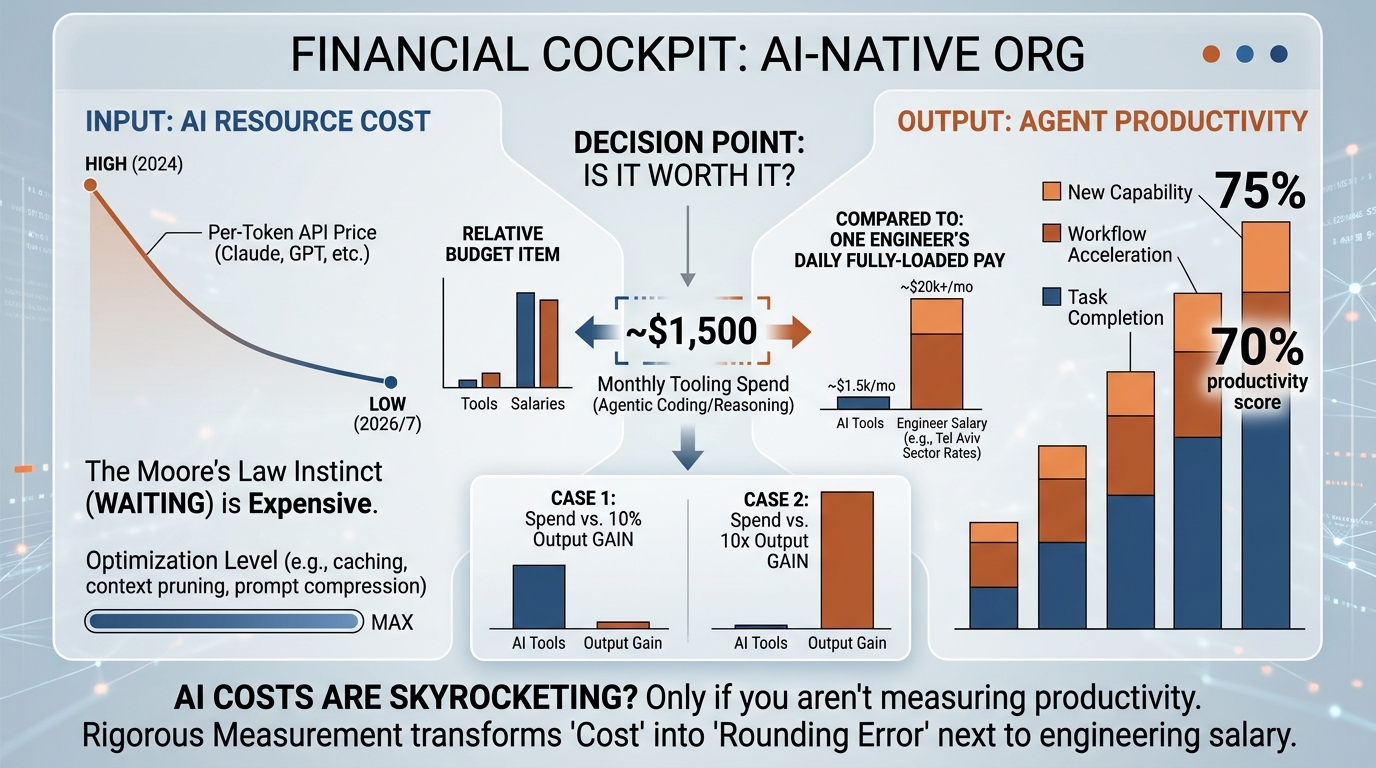 And here’s the number that actually puts my $1,200–$1,500 a month in perspective: that’s roughly one engineer’s daily fully-loaded pay — sometimes half a day, for a senior engineer at Israeli tech-sector rates. If that spend makes an engineer meaningfully more productive across a month, not even 10x, the math isn’t close. It’s the cheapest lever on the org chart, not the most expensive line item on the budget. The mistake isn’t spending $1,500 a month on AI tooling. The mistake is spending it without knowing whether it bought you 10% more output or 10x, because those two outcomes justify wildly different budgets next year. Measure the productivity side of the ledger as rigorously as you measure the token side, and the “AI costs are skyrocketing” headline stops being scary and starts being a rounding error next to one engineer’s salary.
Add to GLOSSARY const in src/layouts/PostLayout.astro: ‘LiteLLM’: { full: ‘LiteLLM (open-source model gateway/router)’, url: ‘https://docs.litellm.ai’ }, —>
Discussion