TL;DR
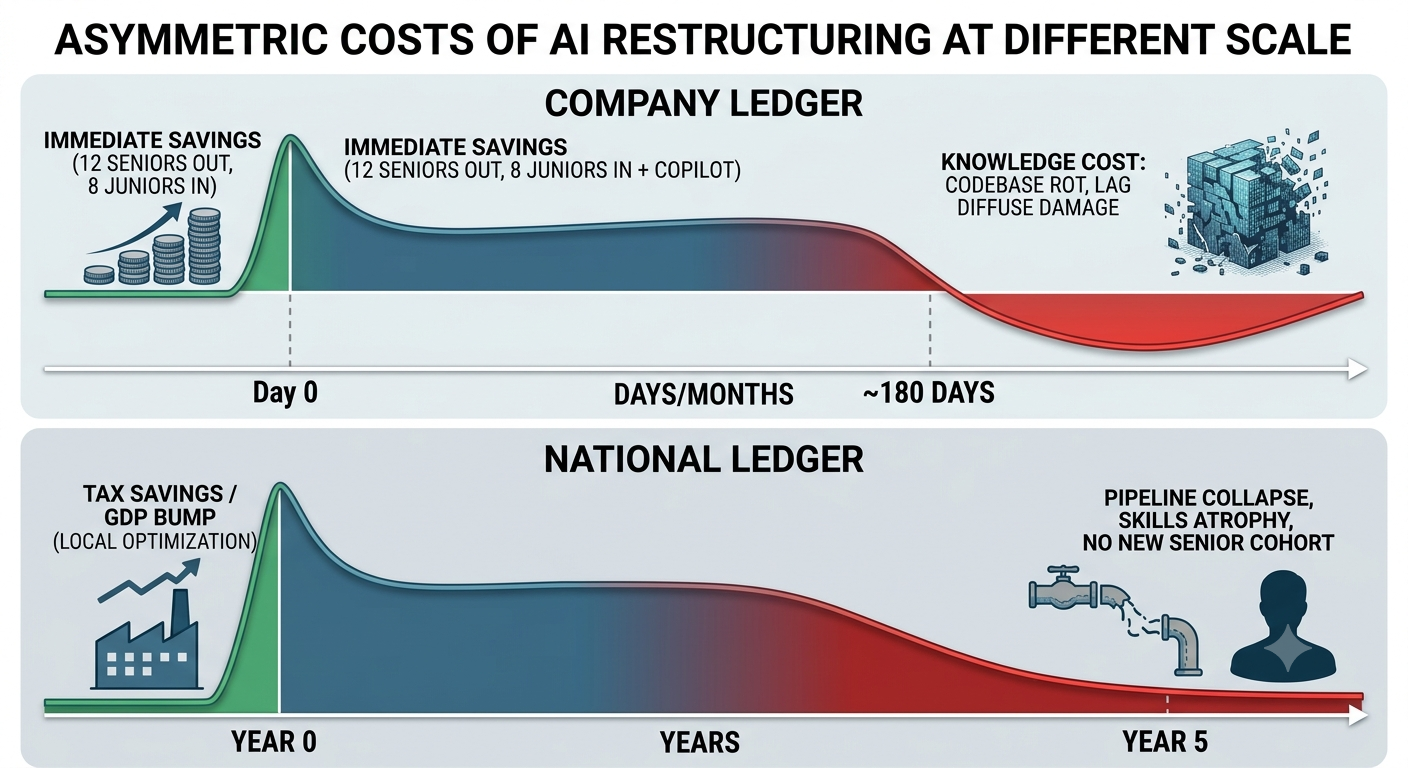
In Part 1 I argued AI was the cover story for bad bets. In Part 2, that the knowledge bill arrives on a company lag — net-180. Here’s the uncomfortable escalation: nations run the same ledger, on net-5-years. Every firm rationally stops hiring juniors; collectively that’s a senior pipeline that doesn’t exist in 2031, and no single company can fix it. That’s a textbook market failure — the one case where “let the market sort it out” is guaranteed to fail. Governments need an AI change plan, but not the press-release kind: one with published lag indicators, funded knowledge transfer, and a junior pipeline backstop.
Originally published at portfolio.hagzag.com.
The Argument Scales Up, and That’s the Problem
I recently watched Joel Pearson’s TEDxSydney talk that ended with a line I haven’t been able to shake: every nation on the planet needs an AI change plan, and none has one. Pearson — a professor of cognitive neuroscience at UNSW — frames it as the “everything disruption” — first cognitive work, then embodied work when the humanoid robots arrive, roughly a hundred companies deep into building them already.
My first instinct was the practitioner’s eye-roll: “national change plan” sounds like the government edition of “AI-driven restructuring” — an announcement, not an outcome. Part 1 of this series was built on exactly that skepticism. But Pearson isn’t selling a plan; he’s a psychologist pointing at the gap between exponential reality and the linear brains trying to budget for it.
But then I ran the Part 2 argument one level up, and the eye-roll stopped.
The company version: cut 12 seniors, backfill with 8 juniors plus Copilot, book the savings this quarter, watch the codebase rot six months later. The savings are immediate and legible; the damage is lagging and diffuse. That asymmetry is why it keeps happening.
The national version is the same ledger with a longer settlement date. Over 150,000 tech jobs cut across 500+ companies in the first five months of 2026, disproportionately mid-career and senior. Junior hiring quietly collapsing because “AI does the junior work now.” Each decision is locally rational. The aggregate is a country that in five years has no cohort ready to become the seniors it just discarded — and by then, the executives who booked the savings and the ministers who watched it happen are all somewhere else.
Why the Market Can’t Fix This One
I’m generally allergic to “the government should do something” as an argument. Most of the time the market corrects faster than a ministry can schedule a meeting. But the junior pipeline is a genuine coordination failure, and it’s worth being precise about why.
Training a junior engineer is an investment with a 2–4 year payoff and near-zero lock-in — the moment they’re productive, a competitor can hire them. In a tight market, firms trained juniors anyway because they had no choice. AI removed the “no choice”: a senior with Claude or Copilot covers the work three juniors used to do, today, with no ramp-up. So every individual firm’s spreadsheet now says stop hiring juniors, and every firm’s spreadsheet is correct.

The problem is that seniors are not born senior. The 2031 staff engineer is the 2026 junior who spent five years breaking things under supervision. Remove the entry point and you haven’t optimized the pipeline — you’ve deleted it. No firm captures the benefit of fixing this alone, so no firm will. That’s the definition of the case where policy exists.
We’ve seen this movie in other trades: countries that let apprenticeships collapse in manufacturing spent decades and billions trying to rebuild vocational pipelines, mostly failing. The difference is those collapses played out over 20 years. This one is playing out over quarters — the exponential-vs-linear gap the talk illustrated with the folded paper reaching the moon at 42 folds. Policy built on last year’s numbers isn’t slightly behind the curve; it’s answering a question nobody is asking anymore.
What a Real Plan Looks Like (Not a Press Release)
Part 2 ended with three recommendations for engineering leaders. They translate to national scale almost mechanically — which tells me the framing is right:
Map the context → a national skills-exposure census. Companies should map who holds critical undocumented knowledge before cutting. Nations should map which sectors, regions, and age cohorts carry exposure — not “AI will affect 40% of jobs” consultancy vapor, but ministry-grade data: how many seniors exited which disciplines, what junior intake looks like per sector, where the pipeline is already severed. You can’t manage what you refuse to measure.
AI as the capture tool → funded knowledge transfer, not generic “reskilling.” Every reskilling program I’ve seen retrains displaced workers into the roles being automated next — teaching people to prompt-engineer their way into a job that won’t exist by graduation. The better instrument is paying for knowledge to flow the other direction: subsidized senior-junior pairing, apprenticeship levies with teeth (firms above a headcount either train juniors or fund those who do — the UK ran this experiment, imperfectly, and it’s still the closest existing template), and incentives for seniors to document and mentor before they exit, using the same AI tooling that displaced them as the capture mechanism.
Watch lag indicators → publish them like inflation numbers. Companies should watch MTTR and PR review depth after cuts. Nations should publish, monthly: graduate time-to-first-job in tech, junior openings as a share of total openings, senior attrition by sector. The talk’s “surprise gap” — the space between linear prediction and exponential reality — is where governments get caught flat-footed. Lag indicators are how you instrument that gap. We treat CPI as a headline number; time-to-first-job for a CS graduate deserves the same treatment, because it’s the leading indicator of the 2031 knowledge bill.
None of this requires predicting AI’s trajectory — which the talk convincingly argues is impossible with this many interacting exponentials. It requires instrumenting the present. That’s not futurism; that’s observability. We solved this problem for distributed systems; the discipline transfers.
What I’d Push Back On
The talk’s weakest moment, for me, was the framing that transition policy “supersedes all other projects on the planet.” That’s how you lose the room. Climate and AI transition aren’t competing projects — a workforce in free-fall funds neither. And the Mad Max unemployment imagery, while honest about tail risk, hands ammunition to people who want to dismiss the whole argument as doomerism. The stronger case is boring: this is an actuarial problem with a known settlement date, and the premium is cheapest now.
I’d also flag my own uncertainty: the net-5-years number is a rhetorical estimate, not a measurement. It could be three; it could be eight. That’s precisely why the lag indicators matter more than the forecast.
Israel Is the Canary, and the Canary Has Numbers
If the national ledger sounds abstract, look at the one economy where it isn’t. Israeli high-tech is about 17% of GDP (NIS 317 billion in 2024) and hit 57% of total exports in H1 2025 — the highest share ever recorded. Per the Innovation Authority, 85% of state revenues from the sector are tied to employment in it — income tax, social security — not to company profits. The national ledger isn’t a metaphor here; it’s the tax base.
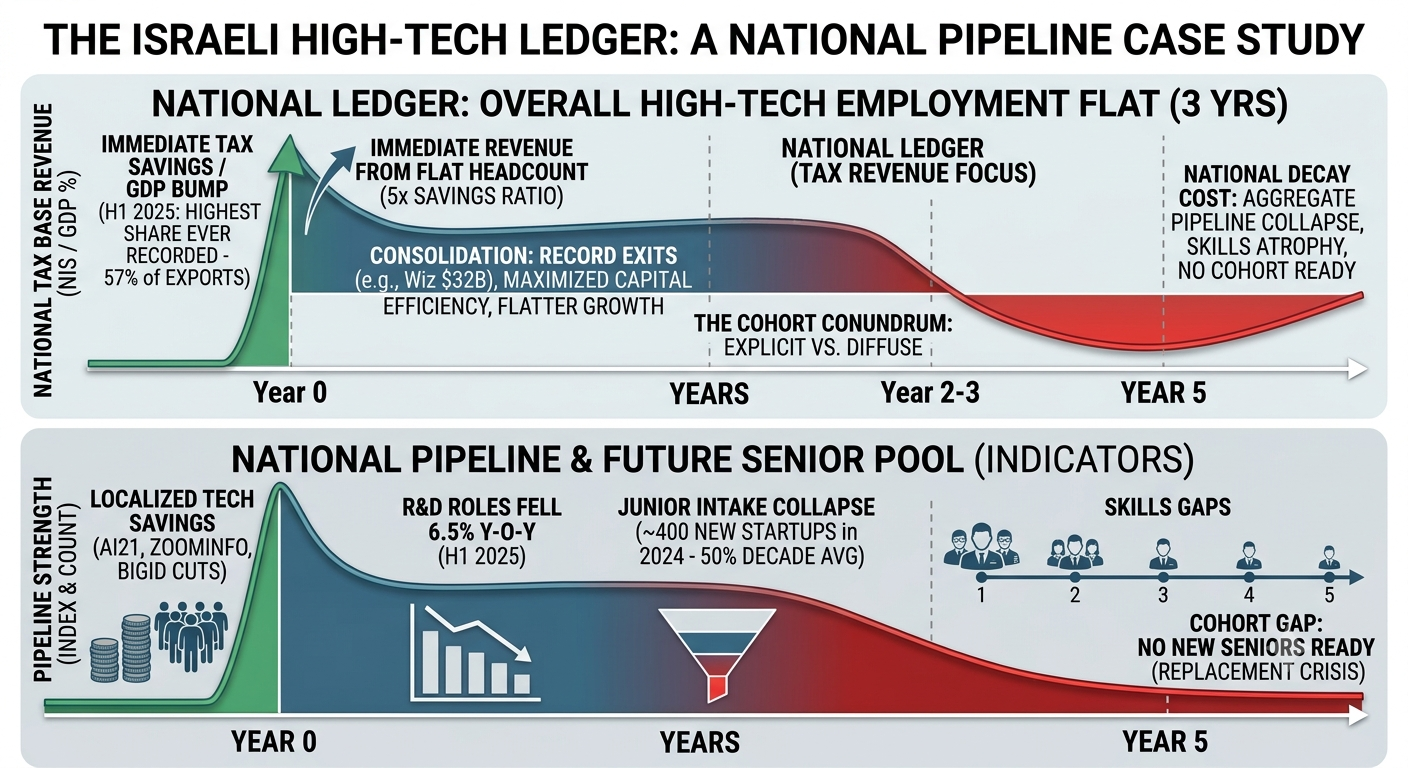
Now the pipeline side of that ledger, from the same Innovation Authority 2025 report: high-tech employment has been stagnant for three consecutive years at ~11.5% of the workforce. R&D roles fell 6.5% year-over-year in H1 2025. Only ~400 new startups were founded in 2024 — roughly half the annual average of the previous decade. Meanwhile exits and fundraising are breaking records — Wiz at $32 billion, a top-5 global fundraising hub.
Read those two paragraphs together and you get the exact company pattern from Part 2, at national scale: the savings side (exits, capital efficiency, record exports from a flat headcount) is booming and legible. The pipeline side (new companies, R&D roles, junior intake) is quietly eroding. The AI21, ZoomInfo, and BigID cuts from Part 1 weren’t anomalies — they were the concentrated version of a global pattern hitting the most exposed economy first. A country whose tax base runs on high-tech employment, watching that employment flatline while celebrating exit records, is a company booking Copilot savings while its seniors walk out the door.
If any country needs a skills-exposure census and published pipeline indicators, it’s this one. We don’t have them. Neither does anyone else — but we’ll feel it first.
Conclusion
The bill in Part 2 arrived at net-180 and landed on a CTO’s desk. The national bill arrives at net-5-years and lands on everyone’s. The only question governments actually control is whether they’ll have been measuring while it accrued.
Add to GLOSSARY const in src/layouts/PostLayout.astro: ‘CPI’: { full: ‘Consumer Price Index’, url: ‘https://en.wikipedia.org/wiki/Consumer_price_index’ }, ‘GDP’: { full: ‘Gross Domestic Product’, url: ‘https://en.wikipedia.org/wiki/Gross_domestic_product’ }, ‘CS’: { full: ‘Computer Science’, url: ” }, (MTTR, PR already flagged in Part 2) —>
Discussion