TL;DR
llm-d reached 1.0 in October and was all over KubeCon NA this month. The headline number is a vendor claim of tokens “5 to 10 times cheaper” than commercial APIs. That’s not the number that matters. In every llm-d benchmark I read, the result came from cache hit rate, not from GPU prices: the router sends each request to the replica that already holds its prompt prefix. Self-hosted inference on Kubernetes is now a solved engineering problem. Whether it’s a good business decision for you depends on a metric most teams don’t track yet.
Originally published at portfolio.hagzag.com.
3,000 coding agents on 544 GPUs
In July I wrote that Kimi K3 was too popular to serve: the best open model of the summer, and Moonshot still had to pause sign-ups because it couldn’t serve demand. My point was that building the model is the easy part. Serving it is a distributed-systems problem.
On October 20, at the PyTorch Conference in San Jose, the llm-d project shipped 1.0. That’s its answer to exactly that problem. The demo that got passed around: IBM Research and Red Hat ran GLM-5.2, a ~753B-parameter mixture-of-experts model with ~39B active, across 544 NVIDIA H100s. They report over 6.6 million output tokens per minute at peak and up to 3,000 concurrent coding agents with zero preemptions (NAND Research, Techzine). The comfortable operating point was 2,500 agents.
Three weeks later, CNCF used KubeCon NA to frame AI inference as a core cloud-native workload. It gave the Kubernetes AI Conformance program’s count as 40 certified platforms and announced a Certified Kubernetes Inference Engineer exam for 2027. When a foundation plans a certification for something, that thing is becoming routine work.
What llm-d actually is (and isn’t)
llm-d is not a model server. vLLM or SGLang still do the inference. llm-d is the layer above them that a single Deployment behind a Service never had:
- An inference-aware router built on the Gateway API Inference Extension. It picks a replica per request based on load, predicted latency and, most importantly, which replica already has that prompt’s prefix in its KV cache.
- Prefill/decode disaggregation. Prompt processing and token generation run in separate pools sized independently, with KV-cache data moved between them over NVIDIA’s NIXL.
- Wide expert parallelism for big MoE models, plus KV-cache offload to CPU memory and storage.
New in 1.0: priority- and fairness-based flow control for multi-tenancy, router hot standby, a DisaggregatedSet resource that rolls prefill and decode replicas together, and agent-aware routing that keeps a multi-turn session on the replica that already holds its context. The config API is now v1 and stable. The project is a CNCF Sandbox project founded by IBM, Red Hat, Google Cloud, CoreWeave and NVIDIA.
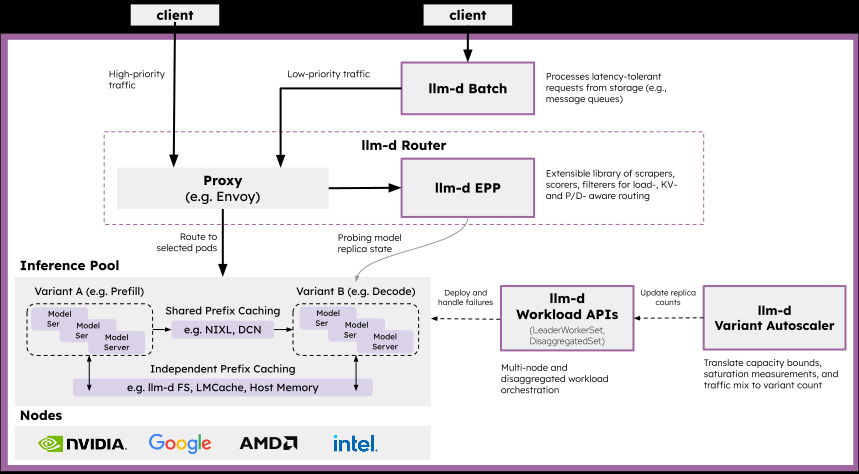 llm-d architecture overview. Source: llm-d project.
The contrarian part: the number that matters is cache hit rate
Every llm-d result I could find comes back to the same lever:
| Workload | What changed | Result |
|---|---|---|
| Google live demo, 1,000 sandboxed agents (Techstrong) | Plain Kubernetes routing → llm-d router | Cache hit rate ~30% → 75%; throughput roughly doubled, latency roughly halved |
| CyberGym agentic benchmark (NAND) | Approximate → precise prefix routing | Prefix hit rate 44% → 73%; throughput +79%; time to first token −67% |
| IBM Research hardware-design workload (NAND) | Agent loop with near-identical prompts | ~98% prefix hit rate; ~$0.11 per million tokens blended |
None of those gains came from a cheaper GPU. They came from not recomputing a prompt the cluster had already seen. And agents are the most cacheable workload there is. A coding agent re-sends the same system prompt, the same tool definitions and the same growing conversation on every turn. A round-robin Service scatters those turns across replicas and makes each one recompute the prefix.

That changes how you should compare build vs. buy. The commercial APIs already do this: Anthropic, OpenAI and Google all bill cached input tokens at a steep discount. So “5–10× cheaper than an API” compares your well-tuned cluster against an API price, possibly without caching. NAND Research calls that cost figure “a hypothesis to test,” and I agree. The fair comparison is your cache hit rate against the provider’s cached-token price.
What actually goes wrong
1.0 isn’t fully boring yet. Router hot standby replaces a failed router, but per NAND Research it “does not recover in-flight requests.” There’s no active-active router and no request-level failover. For agents that run for 40 minutes, a dropped stream means a dropped task.
The good defaults are off. Flow control ships disabled so upgrades don’t change behavior. That’s a sensible choice for a 1.0, but it means a fresh install is still first-come-first-served. Your batch evaluation job can starve your interactive users until somebody configures priority bands.

The scale is not your scale. 544 H100s is a research-lab fleet. In Where Is AI Cost Going my own tooling bill was about $1,200 a month. That buys very few GPU-hours. For most ISVs I work with, the honest answer is still “buy tokens.” That only changes once you have steady volume, data that can’t leave your network, or a fine-tuned open model nobody else will host.
I don’t have a 544-GPU cluster, so here’s the experiment I’d run on a small one. Take 4 vLLM replicas behind a plain Service and replay an agent trace: one 6k-token system prompt, a growing conversation, 50 turns. Round-robin sends consecutive turns to different pods, so at most about a quarter of turns can land on a replica that already holds the prefix. Put a prefix-aware router in front and nearly every turn after the first should hit. That’s the number I’d want before spending anything: hit rate on my trace, before and after. (The “quarter” is arithmetic for 4 replicas, not a measurement.)

What I’d do before buying a single GPU
- Measure your prefix reuse on the API you already use. Most providers report cached input tokens in usage data. If your cached share is low, your prompts aren’t stable enough to benefit, and self-hosting won’t fix that.
- Make prompts cache-friendly first. Put the stable parts (system prompt, tool schemas, repo context) at the front, keep them byte-identical across turns, and put volatile parts last. It’s free, and it pays off on any provider.
- If you do self-host, put an inference-aware router in front from day one. A vLLM
Deploymentbehind a ClusterIPServiceis the 2026 version of running a database without connection pooling. - Turn on flow control and pick your priority bands before the first batch job lands on the cluster.
Conclusion
llm-d 1.0 makes self-hosted inference on Kubernetes boring in the good sense: the routing, disaggregation and multi-tenancy you’d otherwise build yourself now come as a stable, CNCF-hosted v1 API. The decision didn’t get easier, though. It just moved. The question used to be “can we serve a frontier-scale open model?” Now it’s “how often does our workload send the same prefix twice?” Teams that can answer that with a number are ready to choose between building and buying. Everyone else is guessing.
Discussion